
Service Area: San Diego, Orange County, Los Angeles
SB 868 · California Plug-In Solar Law
Last updated: October 2026
Starting January 1, 2027, plug-in solar is legal in California. Senate Bill 868, signed on September 30, 2026, lets you plug a small, certified solar kit into a standard outlet without asking SDG&E for permission or paying a fee.
It is good news for renters and condo owners who have never been able to go solar. Here is what the law allows, what it does not, and how plug-in solar compares with a full rooftop system on a San Diego home.
★★★★★ Rated on Google, Yelp, HomeAdvisor & Thumbtack
SB 868, nicknamed the “Plug Into the Sun Act,” covers what the law calls a portable solar generation device: a solar kit that connects to your home’s wiring through an ordinary outlet. From January 1, 2027:
Plug-in solar, often called balcony solar or plug-and-play solar panels, is one or two panels with a small inverter and a cord that plugs into an outlet. You hang it on a balcony railing, set it on a patio or mount it on a fence. The power goes straight into your home’s circuits and lowers how much you draw from the grid while the sun is out.
The kit must meet the UL 3700 safety standard (or an equivalent). As of October 2026, some plug-in solar inverters have been certified, but [no complete kit had been certified yet]. Certified kits are expected on the market around [spring 2027]. Until then, be wary of kits sold as “California legal.”
You do not need SDG&E’s approval. The law does let utilities ask for a simple online registration listing your address and the kit’s make, model and size. [SDG&E has not yet published its form.] We will update this page when it does.
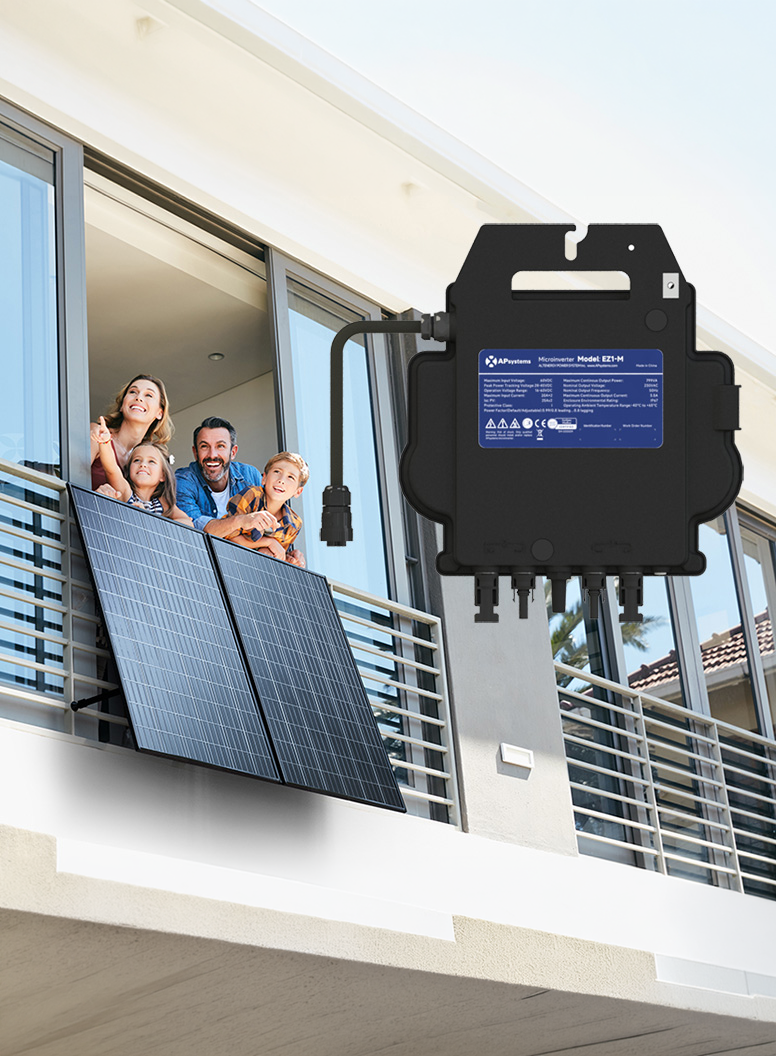
Plug-in solar fills a real gap. It gives people who cannot put panels on a roof a simple, legal way to cut their SDG&E bill a little. Here is who it suits best.
No roof, no permit, and you take it with you when you move. SB 868 does not cover landlords or HOAs, so get written permission before you hang anything on a balcony or patio.
A sunny balcony or patio and an outdoor outlet are all you need. Check your HOA rules first, since the law does not override them.
A plug-in kit is a low-cost way to see solar at work. But if you own your home and your SDG&E bill runs into the hundreds of dollars a month, a 1,200-watt kit will barely move it. That is what rooftop solar for your home is built to do.
Less than most people expect, but it is not nothing. SB 868 does not pay you for power you send back to the grid. A plug-in kit only saves money on electricity your home uses at the moment the panels are producing: the fridge, a home office, an AC unit running in the afternoon.
SDG&E’s average residential rate is about [45 cents per kWh] as of early 2026. A well-placed 1,200-watt kit might produce [1,200 to 1,700 kWh] a year. If your home used every bit of it, that would cut your bill by roughly [$500 to $750] a year. Shade, a balcony facing the wrong way and daytime hours when nobody is home all reduce that, so [a few hundred dollars a year] is more realistic for most setups.
| Plug-in solar (SB 868) | Rooftop solar | |
|---|---|---|
| Size | Up to 1,200 watts AC per home | Typically [5 to 10 kW] for a San Diego home |
| Installation | Plug into an outlet | Licensed installer, permit and SDG&E interconnection |
| Credit for extra power | None | Credit under SDG&E’s current billing rules |
| Backup power in an outage | No | Yes, with a home battery |
| Share of a typical bill offset | Small | Most or all, depending on system size |
| Best for | Renters, condos, small budgets | Homeowners who want real savings |
Solion Energy designs and installs rooftop solar and battery storage across San Diego County. We are a licensed C-10 electrical contractor [LIC # 1075721], so the same team that designs your system handles the electrical work.
[Optional, only if Solion offers it: Planning to add a plug-in kit? We can check that the outlet and circuit you plan to use are in good shape.]
Call (858) 988-9684 or schedule a free site visit, and we will show you what a full system would save on your SDG&E bill.
Yes, from January 1, 2027. SB 868 allows certified plug-in solar kits up to 1,200 watts AC per home without a utility interconnection agreement.
January 1, 2027. The governor signed it on September 30, 2026. Its exemptions expire on January 1, 2030 unless the Legislature extends them.
SDG&E cannot require approval or charge a fee. It can ask you to complete a short online registration with your address and the kit’s make, model and size.
No. Power your kit sends to the grid earns no credit, so the savings come only from power you use at home while the panels produce.
No. A certified kit plugs into a standard outlet. If your outlet or wiring is old, having it checked first is a sensible precaution.
The law does not stop them, but it does not override a lease or HOA rules either. Get written permission from your landlord or HOA first.
It can trim a bill, but at 1,200 watts it offsets only a small share of a typical San Diego home’s use. Homeowners looking for real savings usually get far more from a rooftop system with battery storage.
This page explains SB 868 for general information and is not legal advice. Source: SB 868, Chapter 985, Statutes of 2026.
Opening Hours: Mon-Fri 9am – 5pm
Phone: (858) 988-9684
Email: info@solionenergy.com
★★★★★ Rated on Google, Yelp, HomeAdvisor & Thumbtack
“I couldn’t be more happy with this interaction and overall service they provided. From start to finish, this Team of professionals kept me abreast of their estimate, communicated often, did phenomenal work and followed up to ensure I was happy with the work!”
Anthony M.
Yelp
“Jake was very responsive to our needs and very informative on the options we had for our Solar needs and wants. His timeline was exactly what he stated. If he needed to change the dates he told us why and agreed to keeping us informed. Thanks for everything Jake!”
Daphne Z.
Yelp
Jake did a fantastic job recently installing 22 panels on my home in Point Loma. He was very knowledgeable all the way through the process. He upheld high standards while doing the installation and everything turned out great!
Eric B.
Yelp